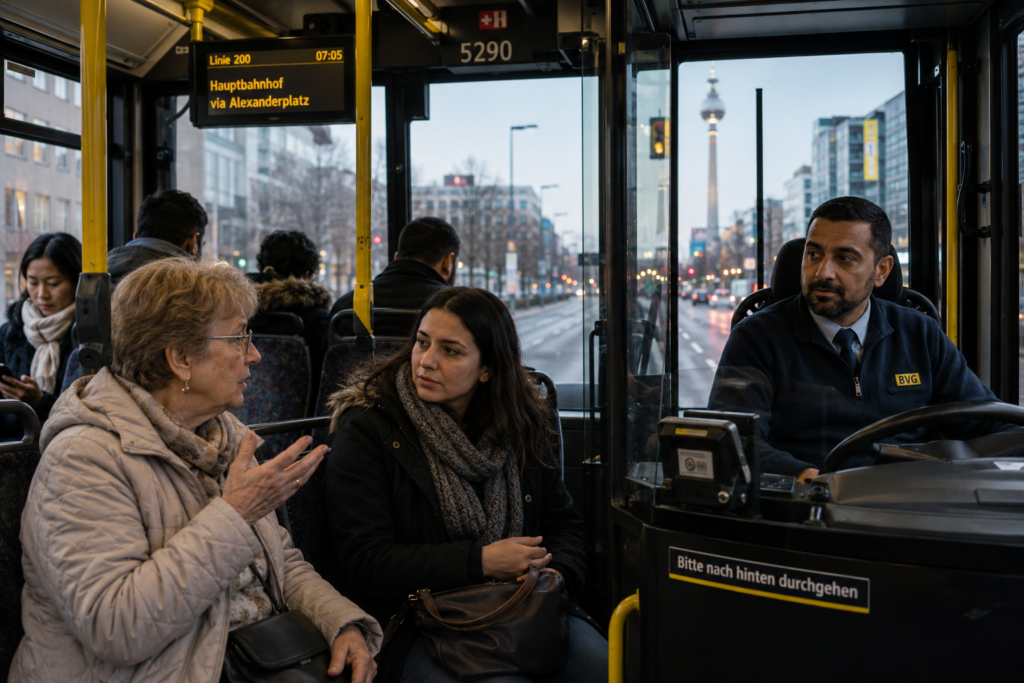
Berlin, 5. Mai, 7.05 Uhr morgens. Ein Bus fährt durch die Hauptstadt. Menschen sitzen müde auf ihren Plätzen, manche schauen aus dem Fenster, andere trinken ihren ersten Kaffee. Eine alltägliche Szene in einer Stadt, die von Vielfalt und Arbeit lebt.
Neben mir sitzt eine ältere Dame. Sie schaut sich um und sagt: „Schauen Sie sich an, wer hier zur Arbeit fährt!“
Ich frage: „Was meinen Sie?“
Sie antwortet: „Alle Menschen hier fahren zur Arbeit, aber die Migranten schlafen noch.“
Ein Satz voller Vorurteile. Ein Satz über Menschen, deren Alltag sie gar nicht kennt.
Ich frage sie: „Sind Sie schon einmal um 4.50 Uhr mit dem Bus gefahren?“
Sie schaut erstaunt. Dann sage ich: „Nehmen Sie einmal den Bus Richtung Hauptbahnhof um 4.50 Uhr. Dort sitzen viele Frauen und Männer mit Migrationshintergrund, die längst auf dem Weg zur Arbeit sind.“
Viele reinigen Büros, arbeiten in Krankenhäusern, fahren Bus, backen Brot oder liefern Waren aus. Während viele Menschen noch schlafen, beginnt für sie der Arbeitstag bereits mitten in der Nacht.
Ich ergänze: „Vielleicht hat sogar unser Busfahrer vorne einen Migrationshintergrund. Haben Sie ihn gesehen?“
Es wird still.
Denn Vorurteile entstehen oft dort, wo Menschen nur ihren kleinen Ausschnitt der Realität sehen. Wer erst um 7 Uhr morgens unterwegs ist, sieht nicht die Reinigungskräfte, Pflegekräfte, Bauarbeiter oder Fahrer, die bereits seit Stunden arbeiten.
Viele Menschen mit Migrationsgeschichte tragen Deutschland jeden Tag mit. Sie arbeiten häufig in Berufen, die körperlich anstrengend und schlecht bezahlt sind – und trotzdem werden sie oft pauschal als faul abgestempelt.
Beim Aussteigen sage ich noch: „Bitte vergessen Sie nicht, einmal den Bus um 4.50 Uhr zu nehmen. Schlafen Sie nicht zu lange! Einen schönen Tag!“
Der Bus fährt weiter.
Doch leider fahren auch die Vorurteile weiter.
Gerade deshalb müssen solche Situationen angesprochen werden – nicht mit Hass, sondern mit Menschlichkeit und Fakten.
Denn eine Gesellschaft zerbricht nicht daran, dass Menschen unterschiedlich aussehen oder unterschiedliche Wurzeln haben. Sie zerbricht daran, wenn Menschen aufhören, einander wirklich wahrzunehmen.
„Es ist die Eigenschaft von Narren, immer zu urteilen.“ – Thomas Fuller
—-
Kommentar von
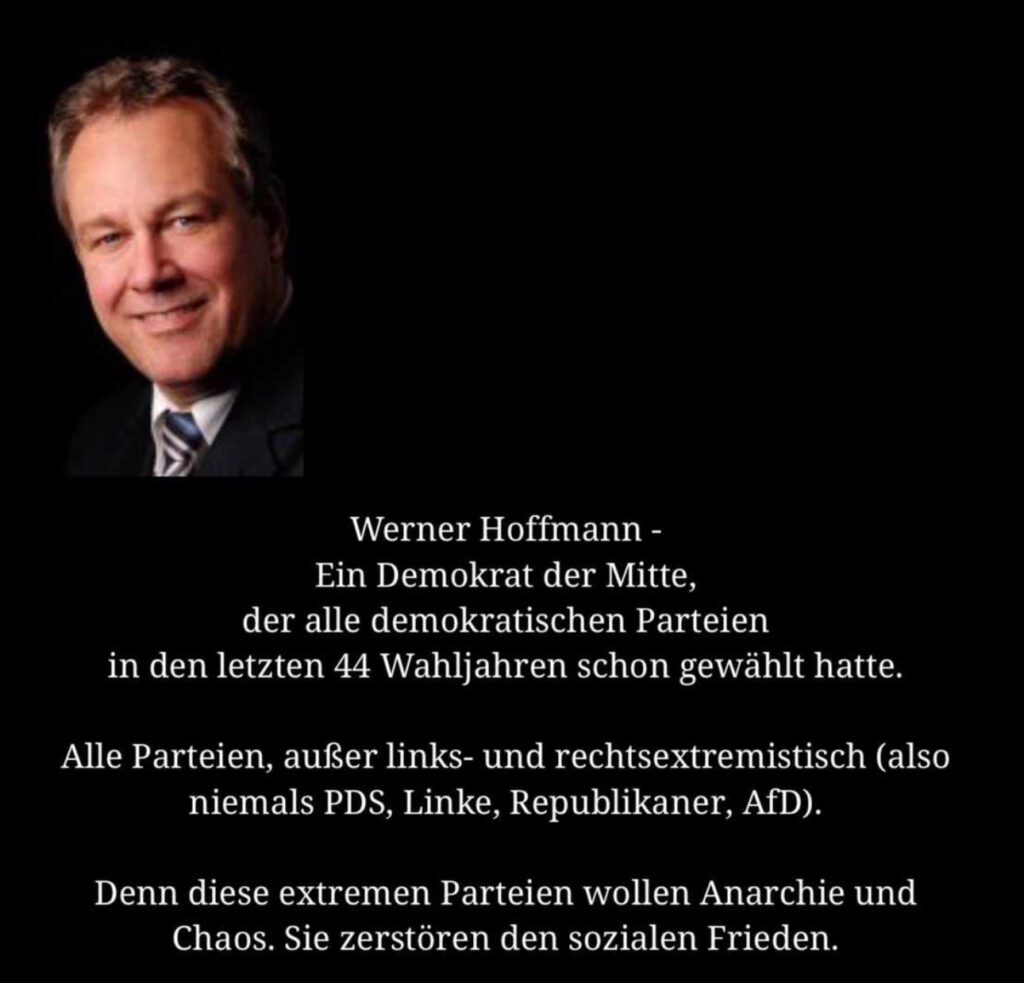
Werner Hoffmann. – Überzeugter demokratischer Europäer. –
Janina, so klasse geschrieben…
Damit hatte die „ältere Dame“ – die wahrscheinlich auch sagt: „Also die Jugend von heute….“- wohl nicht gerechnet.
Der Typus Mensch, der sagt:
„Die Jugend von heute“ ist in der Transaktionsanalyse sehr bekannt (Aktion: Eltern-Ich an Eltern-Ich)
Sie hatte an Ihr Eltern-Ich eine Nachricht gesendet und Sie haben nicht aus dem Eltern-Ich, sondern von Ihrem Erwachsenen-Ich an ihr Erwachsenen-Ich geantwortet.
Das verhindert endlose unnütze Diskussionen und sorgt bei dieser Frau hoffentlich zum nachdenken. Prima
The Munich Security Conference 2025 marks a historic turning point in transatlantic relations.
With his speech, U.S. Vice President J.D. Vance sent an unmistakable signal:
The days of close political coordination between the U.S. and Europe may soon be over.
More than that—his remarks raise fundamental questions about the future of Western democracies.
An Attack on European Democratic Principles
Vance used his appearance before an international audience to deliver sharp criticism of European governments.
In his view, freedom of speech on the continent is increasingly being restricted—an assertion that has been met with strong opposition in Germany and other EU countries.
In Europe, the protection of democratic principles is considered essential.
Combating targeted disinformation or extremist influence is not an attack on democracy but rather its safeguard.
However, the most explosive part of his speech concerned Germany’s political landscape.
Vance urged established parties to reconsider their stance on the AfD and to stop excluding the party from governmental responsibility.
In doing so, he crossed a diplomatic boundary, as there is a broad consensus in Germany that cooperation with extremist forces is out of the question.
Interestingly, after the event, Vance met privately with Alice Weidel at another location. What was discussed between Vance and Weidel remains unknown.
Sharp Reactions from Germany
Berlin’s response was swift.
Both the German government and opposition representatives firmly rejected Vance’s statements.
Bavarian Minister-President Markus Söder made it clear that only German parties and voters decide on political coalitions:
“We will not be dictated to here.”
Similarly, government spokesman Steffen Hebestreit stated that direct interference in German election campaigns was inappropriate.
Foreign Minister Annalena Baerbock emphasized that it is solely up to German voters to determine their government.
The sharpness of the reactions illustrates how much Vance’s words were perceived as an affront.
Not only because they question the sovereignty of European democracies, but also because they hint at a fundamental break with the traditional transatlantic relationship.
Under Trump and Vance, the U.S. no longer seems to position itself primarily as a reliable partner for Europe but rather as a force seeking to redraw political lines—even if this means directly influencing European domestic politics.
A Turning Point for the Transatlantic Partnership?
J.D. Vance’s speech could go down in history as a turning point.
It not only reveals a shift in the U.S.’s self-perception under Trump but also highlights new tensions between Washington and Europe’s capitals.
The fundamental values that have shaped transatlantic cooperation for decades—democracy, the rule of law, and a shared security policy—are apparently being reinterpreted by the new U.S. administration.
For Europe, this presents a clear challenge:
The era of unconditional American support seems to be over.
Germany and its European partners must position themselves more strongly as independent geopolitical players in order to defend their democratic principles and security interests.
The words of German President Frank-Walter Steinmeier at the security conference take on special significance in this context:
“Diplomacy is not a cage fight.”
The coming years will show whether Europe remains true to this principle—and whether the U.S. remains a reliable partner in defending Western values.
My Comment:
The statements and behavior of the new Trump & Vance administration make it clear to me that the U.S. does not want a strong Europe but rather a Trump-loyal following and would prefer to see the EU fragmented as an independent entity.
It is no coincidence that Vance, Trump, and Musk support right-wing populist movements and that they are trying to tear down the barrier against the “largely far-right AfD” in Germany.
Vance’s statements go beyond all diplomatic norms.
Trump will soon realize that he is overplaying his hand!
Trump is attempting to overturn the entire world order—without regard for the existing value system.
Under Trump, the only rule that should apply is the law of the strongest.
And for this, he is using the oligarchy of American billionaires, who also have the greatest control over the media.
Trump, Vance, and Musk do not support right-wing populist organizations because they do not see democracy in Germany and the EU.
No, the real reasons are:
• The European Union, with over 450 million inhabitants, is too strong.
• The EU should revert to fossil energy and become even more dependent on U.S. gas, oil, etc.
• The success of renewable energy in the EU—especially in Germany—bothers the U.S. just as much as it bothers Russia.
Trump is not just causing disruption in the EU—he is shaking up the world at an alarming pace!
Today—The Trump Problem
Regardless of whether it’s Trump’s idea to:
• Buy Gaza and turn it into “Dubai 2 on the Mediterranean” as a real estate deal through third parties,
• Take over Greenland—by force if necessary—using geopolitical security as a pretext, while the real goal is seizing natural resources,
• Incorporate Canada as the 51st state,
• Take control of the Panama Canal,
• Increase tariffs on imports from Mexico, Canada, and China,
• Impose blanket tariffs on steel and aluminum imports,
Trump coldly executes his deals everywhere.
His strategy—demand 10 steps, settle for 2—is one of his success formulas.
His second success strategy is to never admit a mistake. And if caught lying, he simply adds another lie on top.
These will not be his last actions.
Even the so-called Russia-Ukraine peace negotiations will be used by Trump for his own advantage—as his deal.
Rare earth minerals in Ukraine would certainly appeal to Trump.
A Matter of Time Before Attacked Nations Unite
Attempts to weaken the European Union through division will likely only lead to greater unity.
And if certain disruptive elements—such as Hungary—try to harm the EU, this might even result in the formation of a new EU2 with global democratic allies.
Why shouldn’t:
• All EU member states (450 million people),
• Other democratic European countries (e.g., the UK, Norway, Iceland, Liechtenstein),
• Canada,
• Australia,
• New Zealand,
• Japan,
• India,
• South America,
• etc.
form a stronger import-export alliance?
In total, these countries have a combined population of 2.55 billion people!
None of these nations actually need the U.S.
The U.S. has just 340 million inhabitants.
If these nations stand together, Trump would be forced to back down in many areas.
Trump can only act the way he does toward the rest of the world if these countries allow it.